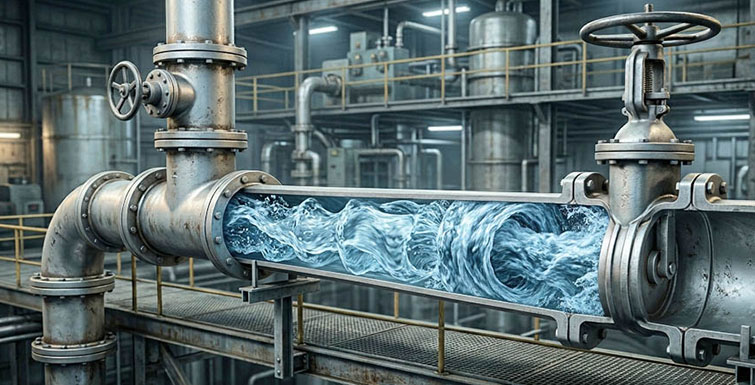

Water hammer is one of the most significant phenomena that must be considered in the design and operation of a hydraulic system. It occurs when the flow of a liquid abruptly changes speed or direction, generating pressure fluctuations that propagate through the piping.
These variations, known as hydraulic transients, can cause pressures higher or lower than normal operating conditions. If not properly analyzed and controlled, they can affect the integrity of the pipes, pumps, valves, fittings, and structures associated with the pressure system.
Although it is commonly associated with a knocking noise inside the pipe, the phenomenon is not always audible. For this reason, its evaluation must take into account the specific hydraulic and operational conditions of each installation.
What Is Water Hammer?
Under normal conditions, a pressurized system operates at specific levels of pressure, velocity, and flow rate. When any of these variables changes suddenly, the fluid’s energy does not disappear immediately: it transforms into a pressure wave that travels through the system.
This wave can increase or decrease the pressure at different points in the system and be reflected by valves, changes in pipe diameter, tanks, pumps, and other components of the system.
The magnitude of the transient depends on various factors, including:
- • Fluid velocity.
- • Operating flow rate.
- • Pipe length and diameter.
- • Pipe material and elasticity.
- • Topographic profile of the system.
- • Pump characteristics.
- • Valve opening and closing times.
- • Maximum and minimum allowable pressures.
- • Equipment start-up and shutdown conditions.
Therefore, not all water hammer events have the same intensity, nor can they be resolved using a standard solution.
What are the main causes of water hammer?
The phenomenon can result from scheduled operational changes or unforeseen events. Among the most common causes are:
• Rapid closing or opening of valves
When a valve closes rapidly, the moving fluid is decelerated in a very short period of time. This can cause a sudden increase in pressure upstream and a decrease in pressure downstream.
The valve’s operating speed, its location, and the characteristics of the piping directly influence the system’s response.
• Sudden pump shutdown
An electrical failure or an emergency shutdown can cause an abrupt decrease in the pumped flow rate. The water column continues to move by inertia, which can lead to pressure drops, flow reversal, and subsequent overpressures.
• Pump startup
Starting one or more pumps also alters the system’s flow rate and pressure. Starting too quickly can cause hydraulic transients, especially in large systems or those with high fluid volumes.
• Power Outages
A power outage can simultaneously shut down the pumps and other control components. Depending on the hydraulic configuration, this event can trigger a complex sequence of pressure drops, flow reversal, and check valve closure.
• Abrupt Closure of Check Valves
When flow reversal occurs, a check valve may close abruptly. This closure can generate significant overpressure and impose additional stresses on the piping and its supports.
• Operational changes to the system
The addition or removal of pumps, speed variations, changes in tank levels, and flow rate modifications can also produce transient conditions that must be considered during design and operation.
What effects can this cause?
Water hammer is not limited to a pressure surge. Depending on the system configuration, it can also cause extremely low pressures and other hydraulic phenomena.
Among its main effects are:
• High Overpressures
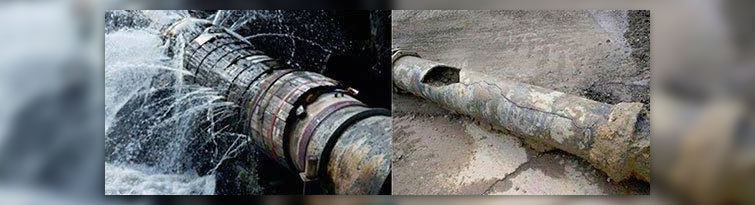
A pressure wave can exceed the design pressure of pipes, valves, joints, and fittings. Repeated occurrences of these events can also accelerate component fatigue, even when no immediate failure occurs.
• Underpressure
A sudden drop in pressure can create near-vacuum conditions, cause deformation in vulnerable pipes, or allow air to enter through points not designed for that purpose.
• Cavitation
When pressure drops below the vapor pressure of the liquid, cavities or vapor bubbles may form. As pressure recovers, these cavities collapse and can cause vibrations, noise, and localized damage.
Cavitation can occur locally or be distributed over a longer section of the pipeline.
• Vibrations and Structural Stresses
Pressure variations generate dynamic forces that can be transmitted to pipes, supports, anchors, valves, and equipment. This can cause movement, vibrations, loosening of joints, or structural damage.
• Operational Failures
Transients can also cause unscheduled activation of protective devices, equipment shutdowns, loss of operational continuity, and increased maintenance requirements.
How can water hammer be controlled or mitigated?
There are various measures to reduce the effects of hydraulic transients. The most appropriate alternative depends on the results of the analysis and the specific conditions of the installation.
Measures that can be evaluated include:
- • Modifying valve opening and closing times.
- • Controlling pump start-up and shutdown ramps.
- • Proper selection of check valves.
- • Installation of air or relief valves.
- • Use of control and automation equipment.
- • Installation of hydropneumatic tanks or damping systems.
- • Combination of different protective devices.
These measures are not necessarily interchangeable. A solution that is appropriate for one installation may prove insufficient or unsuitable for another.
Function of Hydropneumatic Tanks
Hydropneumatic tanks are one of the alternatives used to protect discharge lines against sudden pressure fluctuations.
These devices combine a volume of liquid with a volume of compressible gas. When a pressure change occurs, the gas can compress or expand, allowing the reservoir to temporarily receive or deliver fluid to the system.
In this way, the tank helps reduce the magnitude of overpressures and underpressures, dampening the hydraulic response to transient events.
Depending on the project requirements, different configurations may be considered, including:
- • Hydropneumatic tanks with a diaphragm.
- • Tanks with a compressed air system.
- • Nitrogen-pressurized tanks.
- • Vertical or horizontal configurations.
- • Systems with instrumentation, automation, and control.
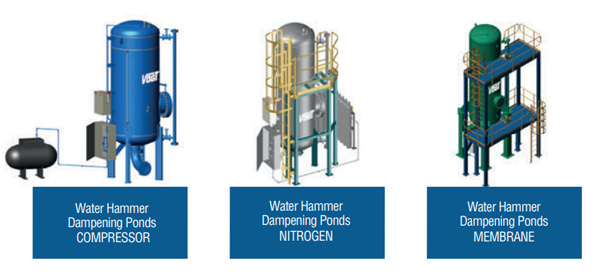
The selection of volume, pressure, configuration, and pressurization system must be based on a hydraulic analysis and actual operating conditions.
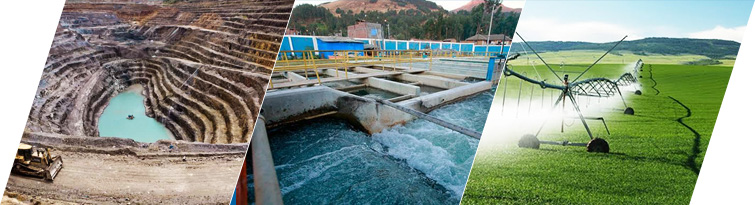
Applications in pumping systems

Water hammer protection solutions may be necessary in facilities across various sectors, such as:
- • Mining.
- • Water treatment plants.
- • Drinking water systems.
- • Wastewater pumping systems.
- • Irrigation systems.
- • Industrial processes.
- • Pump rooms.
- • Extensive discharge lines.
- • Facilities with significant topographic gradients.
In all these cases, the goal is to protect the infrastructure, improve system reliability, and reduce exposure to failures caused by uncontrolled pressure fluctuations.
A solution must take the entire system into account
Protection against water hammer is not simply a matter of installing equipment on a pipeline. It requires an understanding of how pumps, valves, piping, tanks, electrical systems, and control elements interact under various operating conditions.
For this reason, a comprehensive solution may include:
- • Data collection and validation.
- • Hydraulic modeling.
- • Transient analysis.
- • Definition of critical scenarios.
- • Design and sizing of the solution.
- • Manufacturing and supply of equipment.
- • Instrumentation and automation.
- • Installation and connection.
- • Testing and commissioning.
VOGT Solutions for Controlling Hydraulic Transients
At VOGT, we develop solutions to protect pressurized systems against water hammer, taking into account the hydraulic, mechanical, and operational characteristics of each project.
Our scope may include the analysis, design, manufacture, supply, automation, installation, and commissioning of hydropneumatic tanks and damping systems, integrating the components necessary for reliable operation.
Assessing hydraulic transients in advance allows you to identify risks, protect assets, and improve the operational continuity of your facilities.